One Has to Learn Very Earnestly the Art of Listening
| The Importance of Beingness Hostage | |
|---|---|
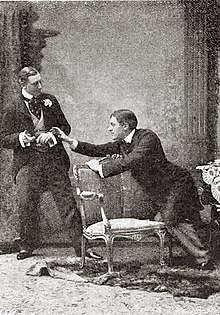 Original product, 1895 | |
| Written by | Oscar Wilde |
| Date premiered | 1895 |
| Place premiered | St James's Theatre, London, England |
| Original language | English language |
| Genre | One-act, farce |
| Setting | London and an estate in Hertfordshire |
The Importance of Being Hostage, A Petty Comedy for Serious People is a play by Oscar Wilde. Kickoff performed on xiv Feb 1895 at the St James's Theatre in London, information technology is a farcical comedy in which the protagonists maintain fictitious personae to escape burdensome social obligations. Working inside the social conventions of late Victorian London, the play'south major themes are the triviality with which it treats institutions as serious every bit spousal relationship, and the resulting satire of Victorian ways. Some gimmicky reviews praised the play'due south humour and the culmination of Wilde'south artistic career, while others were cautious about its lack of social messages. Its high farce and witty dialogue have helped make The Importance of Being Earnest Wilde'southward most enduringly popular play.
The successful opening night marked the climax of Wilde'due south career but too heralded his downfall. The Marquess of Queensberry, whose son Lord Alfred Douglas was Wilde's lover, planned to nowadays the writer with a bouquet of rotten vegetables and disrupt the show. Wilde was tipped off and Queensberry was refused access. Their feud came to a climax in court when Wilde sued for libel. The proceedings provided enough evidence for his arrest, trial and conviction on charges of gross indecency. Wilde's homosexuality was revealed to the Victorian public and he was sentenced to two years imprisonment with hard labour. Despite the play's early success, Wilde's notoriety acquired the play to be closed after 86 performances. After his release from prison house, he published the play from exile in Paris, merely he wrote no more comic or dramatic works.
The Importance of Beingness Earnest has been revived many times since its premiere. It has been adapted for the cinema on three occasions. In The Importance of Being Earnest (1952), Dame Edith Evans reprised her celebrated interpretation of Lady Bracknell; The Importance of Being Earnest (1992) by Kurt Baker used an all-black cast; and Oliver Parker's The Importance of Being Earnest (2002) incorporated some of Wilde'due south original material cutting during the preparation of the first stage production.
Limerick [edit]
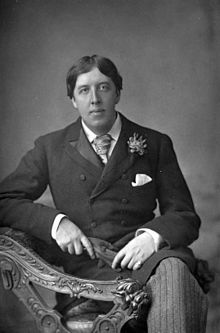
The play was written following the success of Wilde'due south earlier plays Lady Windermere's Fan, An Ideal Husband and A Woman of No Importance.[i] He spent the summer of 1894 with his family at Worthing, where he began work on the new play.[2] His fame now at its peak, he used the working championship Lady Lancing to avoid preemptive speculation most its content.[3] Many names and ideas in the play were borrowed from people or places the author had known; Lady Queensberry, Lord Alfred Douglas's mother, for example, lived at Bracknell.[4] [n 1] Wilde scholars agree the near important influence on the play was W. S. Gilbert's 1877 farce Engaged, [7] from which Wilde borrowed not only several incidents but too "the gravity of tone demanded by Gilbert of his actors".[eight]
Wilde continually revised the text over the next months. No line was left untouched and the revision had significant consequences.[9] Sos Eltis describes Wilde's revisions every bit refined art at work. The earliest and longest handwritten drafts of the play labour over farcical incidents, broad puns, nonsense dialogue and conventional comic turns. In revising, "Wilde transformed standard nonsense into the more systemic and disconcerting illogicality which characterises Hostage'south dialogue".[10] Richard Ellmann argues Wilde had reached his artistic maturity and wrote more surely and chop-chop.[11]
Wilde wrote the function of Jack Worthing with the actor-managing director Charles Wyndham in mind. Wilde shared Bernard Shaw'due south view that Wyndham was the ideal comedy histrion, and based the character on his phase persona.[12] Wyndham accepted the play for product at his theatre, just before rehearsals began he changed his plans, to help a colleague in a sudden crunch. In early 1895, at the St James's Theatre, the actor-manager George Alexander's production of Henry James'south Guy Domville failed, and closed after 31 performances, leaving Alexander in urgent need of a new play to follow it.[13] [14] Wyndham waived his contractual rights and allowed Alexander to stage Wilde's play.[fourteen] [15]
After working with Wilde on stage movements with a toy theatre, Alexander asked the author to shorten the play from four acts to three. Wilde agreed and combined elements of the second and 3rd acts.[16] The largest cut was the removal of the grapheme of Mr. Gribsby, a solicitor who comes from London to arrest the profligate "Ernest" (i.east., Jack) for unpaid dining bills.[9] The four-act version was commencement played on a BBC radio production and is still sometimes performed. Some consider the three-human action construction more effective and theatrically resonant than the expanded published edition.[17]
Productions [edit]
Premiere [edit]
The play was first produced at the St James'due south Theatre on Valentine'due south Day 1895.[18] Information technology was freezing cold but Wilde arrived dressed in "florid sobriety", wearing a green carnation.[16] The audience, according to one written report, "included many members of the great and practiced, former cabinet ministers and privy councillors, as well as actors, writers, academics, and enthusiasts".[19] Allan Aynesworth, who played Algernon Moncrieff, recalled to Hesketh Pearson that "In my 50-three years of acting, I never think a greater triumph than [that] showtime night".[20] Aynesworth was himself "debonair and stylish", and Alexander, who played Jack Worthing, "demure".[21]
The bandage was:
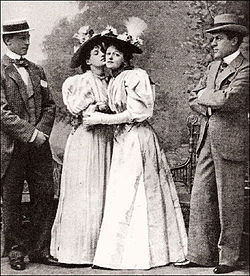

Mrs George Canninge as Miss Prism and Evelyn Millard every bit Cecily Cardew in the premiere
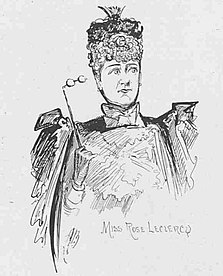
Rose Leclercq as Lady Bracknell, from a sketch of the first product
The Marquess of Queensberry, the father of Wilde's lover Lord Alfred Douglas (who was on vacation in Algiers at the time), had planned to disrupt the play by throwing a bouquet of rotten vegetables at the playwright when he took his bow at the end of the show. Wilde and Alexander learned of the programme, and the latter cancelled Queensberry's ticket and bundled for policemen to bar his entrance. Nonetheless, he connected harassing Wilde, who somewhen launched a individual prosecution against the peer for criminal libel, triggering a series of trials catastrophe in Wilde's imprisonment for gross indecency. Alexander tried, unsuccessfully, to save the production by removing Wilde'due south name from the billing,[n ii] merely the play had to close after only 86 performances.[23]
The play's original Broadway product opened at the Empire Theatre on 22 April 1895, just closed after sixteen performances. Its bandage included William Faversham every bit Algy, Henry Miller as Jack, Viola Allen every bit Gwendolen, and Ida Vernon as Lady Bracknell.[24] The Australian premiere was in Melbourne on 10 August 1895, presented by Dion Boucicault Jr. and Robert Brough, and the play was an immediate success.[25] Wilde'due south downfall in England did not impact the popularity of his plays in Commonwealth of australia.[n three]
Critical reception [edit]

In contrast to much theatre of the time, the light plot of The Importance of Beingness Earnest does not seem to tackle serious social and political bug, something of which contemporary reviewers were wary. Though unsure of Wilde'south seriousness equally a dramatist, they recognised the play'southward cleverness, humour and popularity with audiences.[26] Shaw, for case, reviewed the play in the Saturday Review, arguing that comedy should touch as well equally amuse, "I go to the theatre to exist moved to laughter."[27] Later in a letter he said, the play, though "extremely funny", was Wilde's "first really heartless [one]".[28] In The World, William Archer wrote that he had enjoyed watching the play but found it to be empty of significant: "What can a poor critic do with a play which raises no principle, whether of fine art or morals, creates its own canons and conventions, and is nothing simply an admittedly wilful expression of an irrepressibly witty personality?"[29]
In The Speaker, A. B. Walkley admired the play and was one of few to see it as the culmination of Wilde'southward dramatic career. He denied the term "farce" was derogatory, or even defective in seriousness, and said "It is of nonsense all compact, and better nonsense, I think, our phase has non seen."[30] H. G. Wells, in an unsigned review for The Pall Mall Gazette, chosen Hostage ane of the freshest comedies of the year, saying "More humorous dealing with theatrical conventions information technology would be hard to imagine."[31] He also questioned whether people would fully come across its bulletin, "... how Serious People will take this Trivial Comedy intended for their learning remains to exist seen. No doubt seriously."[31] The play was so lite-hearted that many reviewers compared information technology to comic opera rather than drama. W. H. Auden subsequently (1963) called information technology "a pure verbal opera", and The Times commented, "The story is about too preposterous to go without music."[21] Mary McCarthy, in Sights and Spectacles (1959), still, and despite thinking the play extremely funny, called it "a ferocious idyll"; "depravity is the hero and the only grapheme."[32]
The Importance of Existence Earnest is Wilde'southward most popular piece of work and is continually revived.[33] Max Beerbohm called the play Wilde's "finest, most undeniably his own", saying that in his other comedies – Lady Windermere's Fan, A Adult female of No Importance and An Platonic Husband – the plot, following the mode of Victorien Sardou, is unrelated to the theme of the work, while in Hostage the story is "dissolved" into the form of the play.[34] [n 4]
Revivals [edit]
The Importance of Being Earnest and Wilde'southward three other social club plays were performed in Great britain during the author'due south imprisonment and exile, admitting by small-scale touring companies. A. B. Borer's company toured Hostage between October 1895 and March 1899 (their operation at the Theatre Royal, Limerick, in the last week of Oct 1895 was almost certainly the kickoff production of the play in Ireland). Elsie Lanham's company too toured 'Earnest' between November 1899 and April 1900.[36] Alexander revived Hostage in a pocket-sized theatre in Notting Loma, outside the West Finish, in 1901;[37] in the same twelvemonth he presented the piece on tour, playing Jack Worthing with a bandage including the immature Lilian Braithwaite equally Cecily.[38] The play returned to the West End when Alexander presented a revival at the St James's in 1902.[39] Broadway revivals were mounted in 1902[24] and again in 1910,[twoscore] each product running for six weeks.[24]
A collected edition of Wilde's works, published in 1908 and edited by Robert Ross, helped to restore his reputation every bit an author. Alexander presented some other revival of Hostage at the St James's in 1909, when he and Aynesworth reprised their original roles;[41] the revival ran for 316 performances.[22] Max Beerbohm said that the play was sure to become a classic of the English language repertory, and that its sense of humour was as fresh then every bit when it had been written, adding that the actors had "worn likewise as the play".[42]

For a 1913 revival at the same theatre the young actors Gerald Ames and A. Eastward. Matthews succeeded the creators as Jack and Algy.[43] Leslie Faber as Jack, John Deverell as Algy and Margaret Scudamore every bit Lady Bracknell headed the cast in a 1923 production at the Haymarket Theatre.[44] Many revivals in the outset decades of the 20th century treated "the present" equally the current year. It was non until the 1920s that the example for 1890s costumes was established; as a critic in The Manchester Guardian put it, "Thirty years on, ane begins to feel that Wilde should be washed in the costume of his period – that his wit today needs the backing of the temper that gave information technology life and truth. … Wilde's glittering and circuitous exact felicities become ill with the shingle and the short skirt."[45]
In Sir Nigel Playfair'due south 1930 production at the Lyric, Hammersmith, John Gielgud played Jack to the Lady Bracknell of his aunt, Mabel Terry-Lewis.[46] Gielgud produced and starred in a production at the Globe (now the Gielgud) Theatre in 1939, in a cast that included Edith Evans as Lady Bracknell, Joyce Carey as Gwendolen, Angela Baddeley as Cecily and Margaret Rutherford as Miss Prism. The Times considered the production the all-time since the original, and praised it for its fidelity to Wilde's conception, its "airy, responsive ball-playing quality."[47] Later in the same year Gielgud presented the piece of work again, with Jack Hawkins as Algy, Gwen Ffrangcon-Davies as Gwendolen and Peggy Ashcroft as Cecily, with Evans and Rutherford in their previous roles.[48] The production was presented in several seasons during and after the Second World War, with mostly the aforementioned main players. During a 1946 flavor at the Haymarket the King and Queen attended a performance,[49] which, as the journalist Geoffrey Wheatcroft put it, gave the play "a concluding laurels of respectability."[fifty] [n 5] The production toured North America, and was successfully staged on Broadway in 1947.[52] [n vi]
As Wilde's work came to exist read and performed again, it was The Importance of Being Earnest that received the most productions.[55] Past the time of its centenary the journalist Marker Lawson described it every bit "the second most known and quoted play in English after Hamlet."[56]
For Sir Peter Hall's 1982 production at the National Theatre the cast included Judi Dench as Lady Bracknell,[n 7] Martin Jarvis as Jack, Nigel Havers as Algy, Zoë Wanamaker as Gwendolen and Anna Massey equally Miss Prism.[58] Nicholas Hytner'southward 1993 product at the Aldwych Theatre, starring Maggie Smith, had occasional references to the supposed gay subtext.[59]
In 2005 the Abbey Theatre, Dublin, produced the play with an all-male cast; it also featured Wilde every bit a graphic symbol – the play opens with him drinking in a Parisian café, dreaming of his play.[60] The Melbourne Theatre Visitor staged a production in December 2011 with Geoffrey Rush as Lady Bracknell.[61]
In 2007 Theatre Regal, Bathroom produced the play with Peter Gill directing. Penelope Keith played Lady Bracknell, Harry Hadden-Paton played Jack, William Ellis played Algernon, Gwendolyn was played past Daisy Haggard and Cecily was played by Rebecca Dark. The production went on a curt UK Tour before playing in the West Stop of London at Vaudeville Theatre in 2008 and received positive reviews.[62] [63]
In 2011 the Roundabout Theatre Company produced a Broadway revival based on the 2009 Stratford Shakespeare Festival production featuring Brian Bedford equally manager and as Lady Bracknell. It opened at the American Airlines Theatre on 13 Jan and ran until iii July 2011. The bandage likewise included Dana Ivey as Miss Prism, Paxton Whitehead equally Canon Chasuble, Santino Fontana as Algernon, Paul O'Brien as Lane, Charlotte Parry as Cecily, David Furr as Jack and Sara Topham as Gwendolen.[64] It was nominated for three Tony Awards.[n 8]
The play was also presented internationally, in Singapore, in October 2004, by the British Theatre Playhouse,[67] and the same company brought information technology to London'southward Greenwich Theatre in April 2005.
A 2018 revival was directed by Michael Fentiman for the Vaudeville Theatre, London, every bit part of a flavor of four Wilde plays produced by Dominic Dromgoole. The production received largely negative press reviews.[68] [69] [70] [71] [72] [73]
In 2021, during the Covid-xix pandemic, a group of students from Newcastle Academy filmed a production, including scenes with Wilde himself every bit a graphic symbol, at the Sunderland Empire to raise sensation of struggling theatres and artists who had suffered from negative implications of lockdowns in the United kingdom of great britain and northern ireland. The product received largely positive printing for its message. [74] [75] [76]
Synopsis [edit]
The play is ready in "The Present" (i.due east. 1895).[77]
Act I: Algernon Moncrieff'due south apartment in Half Moon Street, W [edit]
The play opens with Algernon Moncrieff, an idle immature gentleman, receiving his all-time friend, Jack Worthing ('Ernest'). Ernest has come from the land to advise to Algernon'due south cousin, Gwendolen Fairfax. Algernon refuses to consent until Ernest explains why his cigarette case bears the inscription, "From little Cecily, with her fondest honey to her dear Uncle Jack." 'Ernest' is forced to admit to living a double life. In the state, he assumes a serious mental attitude for the do good of his immature ward, the heiress Cecily Cardew, and goes past the name of Jack, while pretending that he must worry about a wastrel younger blood brother named Ernest in London. In the metropolis, meanwhile, he assumes the identity of the libertine Ernest. Algernon confesses a similar deception: he pretends to have an invalid friend named Bunbury in the country, whom he can "visit" whenever he wishes to avoid an unwelcome social obligation. Jack refuses to tell Algernon the location of his country estate.
Gwendolen and her formidable mother Lady Bracknell now call on Algernon who distracts Lady Bracknell in another room while Jack proposes to Gwendolen. She accepts, but seems to love him in large role considering of his name, Ernest. Jack appropriately resolves to himself to be rechristened "Ernest". Discovering them in this intimate exchange, Lady Bracknell interviews Jack every bit a prospective suitor. Horrified to learn that he was adopted later on being discovered as a baby in a bag at Victoria Station, she refuses him and forbids further contact with her girl. Gwendolen manages to covertly promise to him her undying love. As Jack gives her his address in the land, Algernon surreptitiously notes it on the cuff of his sleeve: Jack's revelation of his pretty and wealthy young ward has motivated his friend to meet her.
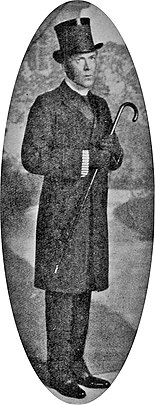
Alexander in Human activity Ii (1909 revival)
Act 2: The Garden of the Manor Firm, Woolton [edit]
Cecily is studying with her governess, Miss Prism. Algernon arrives, pretending to be Ernest Worthing, and soon charms Cecily. Long fascinated by Uncle Jack's hitherto absent blackness sheep brother, she is predisposed to fall for Algernon in his function of Ernest (a proper noun she is manifestly particularly fond of). Therefore, Algernon, also, plans for the rector, Dr. Chasuble, to rechristen him "Ernest". Jack has decided to abandon his double life. He arrives in full mourning and announces his blood brother's death in Paris of a severe chill, a story undermined by Algernon's presence in the guise of Ernest. Gwendolen at present enters, having run away from abode. During the temporary absence of the two men, she meets Cecily, each woman indignantly declaring that she is the 1 engaged to "Ernest". When Jack and Algernon reappear, their deceptions are exposed.
Act Three: Morning time-Room at the Manor House, Woolton [edit]
Arriving in pursuit of her daughter, Lady Bracknell is astonished to be told that Algernon and Cecily are engaged. The revelation of Cecily's wealth soon dispels Lady Bracknell's initial doubts over the young lady's suitability, but any engagement is forbidden by her guardian Jack: he will consent only if Lady Bracknell agrees to his own spousal relationship with Gwendolen – something she declines to do.
The impasse is broken past the return of Miss Prism, whom Lady Bracknell recognises as the person who, 28 years before as a family nursemaid, had taken a baby boy for a walk in a perambulator and never returned. Challenged, Miss Prism explains that she had absent-mindedly put the manuscript of a novel she was writing in the perambulator, and the baby in a handbag, which she had left at Victoria Station. Jack produces the very same purse, showing that he is the lost baby, the elderberry son of Lady Bracknell's belatedly sister, and thus Algernon's elderberry brother. Having acquired such respectable relations, he is adequate as a suitor for Gwendolen afterwards all.
Gwendolen, however, insists she tin can love just a man named Ernest. Lady Bracknell informs Jack that, as the start-born, he would accept been named subsequently his father, General Moncrieff. Jack examines the army lists and discovers that his father's name – and hence his ain real name – was in fact Ernest. Pretence was reality all along. Every bit the happy couples embrace – Jack and Gwendolen, Algernon and Cecily, and even Dr. Chasuble and Miss Prism – Lady Bracknell complains to her newfound relative: "My nephew, you seem to be displaying signs of triviality." "On the reverse, Aunt Augusta", he replies, "I've now realised for the first fourth dimension in my life the vital importance of beingness Earnest."
Characters [edit]
- Jack Worthing (Ernest), a young gentleman from the country, in dearest with Gwendolen Fairfax.
- Algernon Moncrieff, a immature gentleman from London, the nephew of Lady Bracknell, in love with Cecily Cardew.
- Gwendolen Fairfax, a young lady, loved by Jack Worthing.
- Lady Bracknell, a society lady, Gwendolen'southward female parent.
- Cecily Cardew, a young lady, the ward of Jack Worthing.
- Miss Prism, Cecily's governess.
- The Reverend Canon Chasuble, the priest of Jack's parish.
- Lane, Algernon's manservant.
- Merriman, the butler of Jack's country house.
Themes [edit]
Triviality [edit]
Arthur Ransome described The Importance... as the most trivial of Wilde's society plays, and the only one that produces "that peculiar exhilaration of the spirit by which nosotros recognise the beautiful." "Information technology is", he wrote, "precisely because it is consistently trivial that it is not ugly."[78] Ellmann says that The Importance of Beingness Earnest touched on many themes Wilde had been building since the 1880s – the sluggishness of aesthetic poses was well established and Wilde takes information technology as a starting point for the two protagonists.[xi] While Salome, An Ideal Husband and The Picture of Dorian Gray had dwelt on more serious wrongdoing, vice in Earnest is represented by Algy's peckish for cucumber sandwiches.[northward 9] Wilde told Robert Ross that the play's theme was "That we should treat all lilliputian things in life very seriously, and all serious things of life with a sincere and studied triviality."[eleven] The theme is hinted at in the play'southward ironic title, and "earnestness" is repeatedly alluded to in the dialogue, Algernon says in Human action II, "one has to be serious about something if 1 is to have whatsoever amusement in life", simply goes on to reproach Jack for 'existence serious about everything'".[80] Bribery and corruption had haunted the double lives of Dorian Grayness and Sir Robert Chiltern (in An Ideal Husband), but in Earnest the protagonists' duplicity (Algernon's "bunburying" and Worthing's double life equally Jack and Ernest) is undertaken for more innocent purposes – largely to avoid unwelcome social obligations.[11] While much theatre of the time tackled serious social and political bug, Hostage is superficially about nothing at all. It "refuses to play the game" of other dramatists of the period, for example Bernard Shaw, who used their characters to draw audiences to grander ideals.[26]
Every bit a satire of society [edit]
The play repeatedly mocks Victorian traditions and social community, marriage and the pursuit of love in particular.[81] In Victorian times earnestness was considered to be the over-riding societal value, originating in religious attempts to reform the lower classes, it spread to the upper ones as well throughout the century.[82] The play's very title, with its mocking paradox (serious people are so because they practise non meet little comedies), introduces the theme, information technology continues in the drawing room discussion, "Yes, just yous must be serious about it. I hate people who are not serious about meals. It is so shallow of them," says Algernon in Act 1; allusions are quick and from multiple angles.[80]

Gwendolen (Irene Vanbrugh), Merriman (Frank Dyall) and Cecily (Evelyn Millard), in the original production, Act Two
The men follow traditional matrimonial rites, whereby suitors admit their weaknesses to their prospective brides, but the foibles they excuse are ridiculous, and the farce is congenital on an absurd confusion of a book and a baby.[83] When Jack apologises to Gwendolen during his union proposal information technology is for not being wicked:[84]
JACK: Gwendolen, it is a terrible thing for a man to find out all of a sudden that all his life he has been speaking aught but the truth. Tin you forgive me?
GWENDOLEN: I can. For I feel that you are certain to change.
In turn, both Gwendolen and Cecily take the ideal of marrying a man named Ernest, a popular and respected name at the fourth dimension. Gwendolen, quite dissimilar her mother's methodical analysis of Jack Worthing's suitability as a hubby, places her entire religion in a Christian name, declaring in Act I, "The only actually safe proper noun is Ernest".[85] This is an stance shared by Cecily in Act II, "I pity any poor married woman whose husband is non chosen Ernest"[86] and they indignantly declare that they have been deceived when they find out the men's real names.
Wilde embodied lodge's rules and rituals artfully into Lady Bracknell: minute attention to the details of her fashion created a comic issue of assertion by restraint.[87] In contrast to her encyclopaedic knowledge of the social distinctions of London'south street names, Jack's obscure parentage is subtly evoked. He defends himself confronting her "A handbag?" with the description, "The Brighton Line". At the fourth dimension, Victoria Station consisted of two separate simply next terminal stations sharing the same proper noun. To the east was the ramshackle LC&D Railway, on the west the upwards-market LB&SCR – the Brighton Line, which went to Worthing, the fashionable, expensive town the gentleman who found babe Jack was travelling to at the fourth dimension (and after which Jack was named).[88]
Suggested homosexual subtext [edit]
Queer scholars take argued that the play's themes of duplicity and ambivalence are inextricably spring upwardly with Wilde's homosexuality, and that the play exhibits a "flickering presence-absence of... homosexual desire".[89] On re-reading the play after his release from prison house, Wilde said: "It was extraordinary reading the play over. How I used to toy with that Tiger Life."[89]
Information technology has been said that the utilize of the proper name Hostage may have been a homosexual in-joke.[ninety] In 1892, three years before Wilde wrote the play, John Gambril Nicholson had published the volume of pederastic poetry Love in Earnest. The sonnet Of Boys' Names included the verse: "Though Frank may ring like silverish bell / And Cecil softer music claim / They cannot work the miracle / –'Tis Ernest sets my heart a-flame."[91] The word "earnest" may also have been a code-discussion for homosexual, as in: "Is he hostage?", in the same way that "Is he then?" and "Is he musical?" were employed.[xc] Sir Donald Sinden, an actor who had met two of the play's original cast (Irene Vanbrugh and Allan Aynesworth), and Lord Alfred Douglas, wrote to The Times to dispute suggestions that "Earnest" held whatsoever sexual connotations:[92]
Although they had aplenty opportunity, at no time did whatsoever of them even hint that "Earnest" was a synonym for homosexual, or that "bunburying" may have implied homosexual sex. The outset time I heard information technology mentioned was in the 1980s and I immediately consulted Sir John Gielgud whose own performance of Jack Worthing in the same play was legendary and whose cognition of theatrical lore was encyclopaedic. He replied in his ringing tones: "No-No! Nonsense, absolute nonsense: I would have known".[92]
A number of theories have also been put forward to explicate the derivation of Bunbury, and Bunburying, which are used in the play to imply a secretive double life. It may have derived from Henry Shirley Bunbury, a hypochondriacal acquaintance of Wilde'south youth.[93] Another suggestion, put forward in 1913 by Aleister Crowley, who knew Wilde, was that Bunbury was a combination word: that Wilde had once taken a railroad train to Banbury, met a schoolboy at that place, and arranged a second surreptitious meeting with him at Sunbury.[94]
Bunburying [edit]
Bunburying is a stratagem used by people who demand an alibi for avoiding social obligations in their daily life. The word "bunburying" first appears in Act I when Algernon explains that he invented a fictional friend, a chronic invalid named "Bunbury", to have an alibi for getting out of events he does not wish to nourish, particularly with his Aunt Augusta (Lady Bracknell). Algernon and Jack both utilise this method to secretly visit their lovers, Cecily and Gwendolen.[95] [96]
Dramatic analysis [edit]
Use of linguistic communication [edit]
While Wilde had long been famous for dialogue and his apply of language, Raby (1988) argues that he accomplished a unity and mastery in Earnest that was unmatched in his other plays, except perhaps Salomé. While his before comedies endure from an unevenness resulting from the thematic clash between the trivial and the serious, Earnest achieves a pitch-perfect style that allows these to deliquesce.[97] There are three dissimilar registers detectable in the play. The dandyish insouciance of Jack and Algernon – established early with Algernon's commutation with his manservant – betrays an underlying unity despite their differing attitudes. The formidable pronouncements of Lady Bracknell are as startling for her employ of hyperbole and rhetorical extravagance every bit for her disconcerting opinions. In contrast, the speech of Dr. Chasuble and Miss Prism is distinguished by "pedantic precept" and "idiosyncratic diversion".[97] Furthermore, the play is full of epigrams and paradoxes. Max Beerbohm described it as littered with "chiselled apophthegms – witticisms unrelated to action or grapheme", of which he found half a dozen to be of the highest order.[42]
Lady Bracknell's line, "A pocketbook?", has been called one of the nigh malleable in English drama, lending itself to interpretations ranging from incredulous or scandalised to baffled. Edith Evans, both on stage and in the 1952 film, delivered the line loudly in a mixture of horror, incredulity and condescension.[98] Stockard Channing, in the Gaiety Theatre, Dublin in 2010, hushed the line, in a critic's words, "with a barely audible 'A handbag?', rapidly swallowed up with a sharp intake of jiff. An understated take, to exist sure, but with such a well-known play, packed full of witticisms and aphorisms with a life of their ain, information technology'south the little things that brand a difference."[99]
Characterisation [edit]
Though Wilde deployed characters that were by at present familiar – the dandy lord, the overbearing dame, the woman with a past, the puritan young lady – his handling is subtler than in his before comedies. Lady Bracknell, for example, embodies respectable, upper-course society, merely Eltis notes how her development "from the familiar overbearing duchess into a quirkier and more agonizing character" can exist traced through Wilde's revisions of the play.[ten] For the two young men, Wilde presents non stereotypical stage "dudes" but intelligent beings who, every bit Jackson puts it, "speak like their creator in well-formed complete sentences and rarely utilize slang or vogue-words".[100] Dr Chasuble and Miss Prism are characterised by a few light touches of detail, their onetime-fashioned enthusiasms, and the Canon's fastidious pedantry, pared downward past Wilde during his many redrafts of the text.[100]
Structure and genre [edit]
Ransome argues that Wilde freed himself by abandoning the melodrama, the bones construction which underlies his earlier social comedies, and basing the story entirely on the Hostage/Ernest verbal conceit. Freed from "living up to whatsoever drama more serious than chat" Wilde could now charm himself to a fuller extent with quips, bons mots , epigrams and repartee that really had little to do with the business at hand.[101]
The genre of the Importance of Being Earnest has been deeply debated by scholars and critics akin who have placed the play inside a wide variety of genres ranging from parody to satire. In his critique of Wilde, Foster argues that the play creates a world where "real values are inverted [and], reason and unreason are interchanged".[102] Similarly, Wilde's use of dialogue mocks the upper classes of Victorian England lending the play a satirical tone.[103] Reinhart further stipulates that the apply of farcical humour to mock the upper classes "merits the play both every bit satire and as drama".[104]
Publication [edit]
First edition [edit]

Title pages of the first edition, 1899, with Wilde'southward name omitted from the first page, and the dedication to Robbie Ross on the 2d
Wilde'south two final comedies, An Ideal Husband and The Importance of Being Earnest, were withal on stage in London at the time of his prosecution, and they were soon closed every bit the details of his case became public. Later 2 years in prison with hard labour, Wilde went into exile in Paris, sick and depressed, his reputation destroyed in England. In 1898, when no i else would, Leonard Smithers agreed with Wilde to publish the two final plays. Wilde proved to be a diligent reviser, sending detailed instructions on stage directions, grapheme listings and the presentation of the volume, and insisting that a playbill from the outset operation be reproduced inside. Ellmann argues that the proofs testify a homo "very much in command of himself and of the play".[105] Wilde's name did not appear on the cover, it was "Past the Writer of Lady Windermere'southward Fan".[106] His return to work was brief though, as he refused to write anything else, "I can write, just take lost the joy of writing".[105] On 19 October 2007, a get-go edition (number 349 of 1,000) was discovered inside a handbag in an Oxfam store in Nantwich, Cheshire. Staff were unable to trace the donor. It was sold for £650.[107]
In translation [edit]
The Importance of Beingness Earnest 'due south popularity has meant it has been translated into many languages, though the homophonous pun in the title ("Ernest", a masculine proper proper name, and "earnest", the virtue of steadfastness and seriousness) poses a special problem for translators. The easiest case of a suitable translation of the pun, perpetuating its sense and meaning, may have been its translation into German. Since English and German are closely related languages, High german provides an equivalent describing word ("ernst") and besides a matching masculine proper proper name ("Ernst"). The meaning and tenor of the wordplay are exactly the same. Yet at that place are many dissimilar possible titles in German, mostly concerning sentence structure. The 2 nearly common ones are "Bunbury oder ernst / Ernst sein ist alles" and "Bunbury oder wie wichtig es ist, ernst / Ernst zu sein".[82] In a study of Italian translations, Adrian Pablé establish thirteen different versions using eight titles. Since wordplay is often unique to the language in question, translators are faced with a option of either staying true-blue to the original – in this instance the English adjective and virtue earnest – or creating a similar pun in their own language.[108]

Four chief strategies have been used by translators. The offset leaves all characters' names unchanged and in their original spelling: thus the name is respected and readers reminded of the original cultural setting, only the liveliness of the pun is lost.[109] Eva Malagoli varied this source-oriented approach by using both the English language Christian names and the describing word earnest, thus preserving the pun and the English language graphic symbol of the play, but possibly straining an Italian reader.[110] A 3rd group of translators replaced Ernest with a name that also represents a virtue in the target language, favouring transparency for readers in translation over fidelity to the original.[110] For instance, in Italian, these versions variously call the play L'importanza di essere Franco/Severo/Fedele, the given names being respectively the values of honesty, propriety, and loyalty.[111] French offers a closer pun: "Constant" is both a first name and the quality of steadfastness, so the play is commonly known as De l'importance d'être Constant, though Jean Anouilh translated the play under the title: Il est important d'être Aimé ("Aimé" is a name which as well ways "beloved").[112] These translators differ in their attitude to the original English honorific titles, some alter them all, or none, but most go out a mix partially as a compensation for the added loss of Englishness. Lastly, 1 translation gave the name an Italianate touch by rendering information technology as Ernesto; this piece of work liberally mixed proper nouns from both languages.[113]
Adaptations [edit]
Moving-picture show [edit]
Autonomously from several "made-for-telly" versions, The Importance of Being Earnest has been adapted for the English-language picture palace at least three times, first in 1952 past Anthony Asquith who adjusted the screenplay and directed it. Michael Denison (Algernon), Michael Redgrave (Jack), Edith Evans (Lady Bracknell), Dorothy Tutin (Cecily), Joan Greenwood (Gwendolen), and Margaret Rutherford (Miss Prism) and Miles Malleson (Canon Chasuble) were among the cast.[114] In 1992 Kurt Baker directed a version using an all-black cast with Daryl Keith Roach as Jack, Wren T. Brown as Algernon, Ann Weldon equally Lady Bracknell, Lanei Chapman every bit Cecily, Chris Calloway equally Gwendolen, CCH Pounder as Miss Prism, and Brock Peters as Doctor Chasuble, fix in the The states.[115] Oliver Parker, a manager who had previously adjusted An Platonic Husband by Wilde, made the 2002 pic; it stars Colin Firth (Jack), Rupert Everett (Algy), Judi Dench (Lady Bracknell), Reese Witherspoon (Cecily), Frances O'Connor (Gwendolen), Anna Massey (Miss Prism), and Tom Wilkinson (Canon Chasuble).[116] Parker's accommodation includes the dunning solicitor Mr. Gribsby who pursues "Ernest" to Hertfordshire (nowadays in Wilde'south original draft, but cut at the behest of the play's first producer).[18] Algernon too is pursued by a group of creditors in the opening scene.
A 2008 Telugu language romantic comedy moving-picture show, titled Ashta Chamma, is an adaptation of the play.[117]
Operas and musicals [edit]
In 1960, Ernest in Love was staged Off-Broadway. The Japanese all-female musical theatre troupe Takarazuka Revue staged this musical in 2005 in two productions, one past Moon Troupe and the other ane by Bloom Troupe.
In 1963, Erik Chisholm composed an opera from the play, using Wilde's text every bit the libretto.[118]
In 1964, Gerd Natschinski composed the musical Mein Freund Bunbury based on the play, 1964 premiered at Metropol Theater Berlin.[119]
According to a written report past Robert Tanitch, past 2002 there had been least viii adaptations of the play as a musical, though "never with conspicuous success".[59] The primeval such version was a 1927 American bear witness entitled Oh Earnest. The journalist Mark Bostridge comments, "The libretto of a 1957 musical adaptation, Half in Earnest, deposited in the British Library, is scarcely more encouraging. The curtain rises on Algy strumming away at the piano, singing 'I tin can play Chopsticks, Lane'. Other songs include 'A Bunburying I Must Go'."[59] [n 10]
Gerald Barry created the 2011 opera, The Importance of Existence Hostage, commissioned by the Los Angeles Combo and the Barbican Centre in London. It was premiered in Los Angeles in 2011. The phase premiere was given by the Opéra national de Lorraine in Nancy, France in 2013.[121]
In 2017, Odyssey Opera of Boston presented a fully staged product of Mario Castelnuovo-Tedesco'due south opera The Importance of Being Hostage equally office of their Wilde Opera Nights series which was a flavor-long exploration of operatic works inspired by the writings and world of Oscar Wilde.[122] The opera for two pianos, percussion and singers was equanimous in 1961-two. It is filled with musical quotes at every plough. The opera was never published, but it was performed twice: the premiere in Monte Carlo (1972 in Italian) and in La Guardia, NY (1975). Odyssey Opera was able to obtain the manuscript from the Library of Congress with the permission of the composer's granddaughter.[123] After Odyssey's production at the Wimberly Theatre, Calderwood Pavilion at the Boston Center for the Arts on 17 and 18 March, being received with disquisitional acclaim,[124] [125] [126] [127] [128] [129] The Boston Earth stated "Odyssey Opera recognizes 'The Importance of Beingness Earnest.'"[130]
Stage pastiche [edit]
In 2016 Irish player/writers Helen Norton and Jonathan White wrote the comic play To Hell in a Handbag which retells the story of Importance from the point of view of the characters Canon Chasuble and Miss Prism, giving them their own dorsum story and showing what happens to them when they are non on stage in Wilde's play.[131]
Radio and television [edit]
There have been many radio versions of the play. In 1925 the BBC circulate an adaptation with Hesketh Pearson as Jack Worthing.[132] Further broadcasts of the play followed in 1927 and 1936.[133] In 1977, BBC Radio iv broadcast the 4-act version of the play, with Fabia Drake as Lady Bracknell, Richard Pasco as Jack, Jeremy Clyde as Algy, Maurice Denham as Canon Chasuble, Sylvia Coleridge equally Miss Prism, Barbara Leigh-Hunt every bit Gwendolen and Prunella Scales equally Cecily. The production was later released on CD.[134]
To commemorate the centenary of the first performance of the play, Radio 4 broadcast a new adaptation on 13 Feb 1995; directed by Glyn Dearman, it featured Judi Dench as Lady Bracknell, Michael Hordern as Lane, Michael Sheen every bit Jack Worthing, Martin Clunes equally Algernon Moncrieff, John Moffatt as Catechism Chasuble, Miriam Margolyes as Miss Prism, Samantha Bond as Gwendolen and Amanda Root as Cecily. The production was later issued on audio cassette.[135]
On thirteen December 2000, BBC Radio 3 broadcast a new adaptation directed by Howard Davies starring Geraldine McEwan every bit Lady Bracknell, Simon Russell Beale as Jack Worthing, Julian Wadham as Algernon Moncrieff, Geoffrey Palmer as Canon Chasuble, Celia Imrie equally Miss Prism, Victoria Hamilton as Gwendolen and Emma Fielding as Cecily, with music composed by Dominic Muldowney. The production was released on audio cassette.[136]
A 1964 commercial telly adaptation starred Ian Carmichael, Patrick Macnee, Susannah York, Fenella Fielding, Pamela Chocolate-brown and Irene Handl.[137]
BBC telly transmissions of the play have included a 1974 Play of the Month version starring Coral Browne every bit Lady Bracknell with Michael Jayston, Julian Holloway, Gemma Jones and Celia Bannerman.[138] Stuart Burge directed another adaptation in 1986 with a bandage including Gemma Jones, Alec McCowen, Paul McGann and Joan Plowright.[139]
It was adapted for Australian Goggle box in 1957.
Commercial recordings [edit]
Gielgud's performance is preserved on an EMI sound recording dating from 1952, which also captures Edith Evans's Lady Bracknell. The cast likewise includes Roland Culver (Algy), Jean Cadell (Miss Prism), Pamela Brown (Gwendolen) and Celia Johnson (Cecily).[140]
Other audio recordings include a "Theatre Masterworks" version from 1953, directed and narrated by Margaret Webster, with a cast including Maurice Evans, Lucile Watson and Mildred Natwick;[141] a 1989 version by California Artists Radio Theatre, featuring Dan O'Herlihy Jeanette Nolan, Les Tremayne and Richard Erdman;[142] and one past L.A. Theatre Works issued in 2009, featuring Charles Busch, James Marsters and Andrea Bowen.[143]
Notes [edit]
- ^ "Bunburying", which indicates a double life as an excuse for absence, is – according to a letter from Aleister Crowley to R. H. Bruce Lockhart – an within joke that came nearly subsequently Wilde boarded a train at Banbury on which he met a schoolboy. They got into conversation and after bundled to meet again at Sunbury.[5] Carolyn Williams in a 2010 written report writes that for the word "Bunburying", Wilde "braids the 'Belvawneying' evil eye from Gilbert's Engaged (1877) with 'Bunthorne' from Patience".[6]
- ^ This caused a breach betwixt the author and player which lasted for some years; Alexander after paid Wilde small monthly sums, and bequeathed his rights in the play to the author's son Vyvian The netherlands.[22]
- ^ In a 2003 study, Richard Fotheringham writes that in Australia, unlike United kingdom and the US, Wilde's name was non excluded from billings, and the critics and public took a much more than relaxed view of Wilde'south crimes. A command functioning of the play was given by Boucicault'due south visitor in the presence of the Governor of Victoria.[25]
- ^ Victorien Sardou was a French dramatist known for his careful, simply rather mechanical, plotting.[35]
- ^ George VI was not the beginning British king who had attended a functioning of the play: his grandfather Edward VII, when Prince of Wales, was in the audience for the first production.[51]
- ^ Rutherford switched roles, from Miss Prism to Lady Bracknell for the North American production; Jean Cadell played Miss Prism. Robert Flemyng played Algy.[53] The bandage was given a special Tony Honour for "Outstanding Foreign Visitor".[54]
- ^ 20-three years earlier Dench had played Cecily to the Lady Bracknell of Fay Compton in a 1959 Sometime Vic product that included in the cast Alec McCowen, Barbara Jefford and Miles Malleson.[57]
- ^ Best Revival of a Play, Best Costume Design of a Play and Best Leading Thespian in a Play for Bedford (winning for costumes).[65] The product was filmed live in March 2011 and was shown in cinemas in June 2011.[66]
- ^ Wilde himself obviously took sandwiches with due seriousness. Max Beerbohm recounted in a letter to Reggie Turner Wilde's difficulty in obtaining a satisfactory offering: "He ordered a watercress sandwich: which in due course was brought to him: not a thin, diaphanous dark-green thing such every bit he had meant simply a very stout satisfying article of food. This he ate with assumed disgust (but evident relish) and when he paid the waiter, he said: 'Tell the melt of this restaurant with the compliments of Mr Oscar Wilde that these are the very worst sandwiches in the whole globe and that, when I ask for a watercress sandwich, I practise not hateful a loaf with a field in the middle of information technology.'"[79]
- ^ Since Bostridge wrote his commodity at least one farther musical version of the play has been staged. A show with a volume past Douglas Livingstone and score by Adam McGuinness and Zia Moranne was staged in December 2011 at the Riverside Studios, Hammersmith; the bandage included Susie Blake, Gyles Brandreth and Edward Petherbridge.[120]
References [edit]
- ^ Edwards, Owen Dudley. "Wilde, Oscar Fingal O'Flahertie Wills (1854–1900), writer", Oxford Dictionary of National Biography, 2004. Retrieved 6 April 2021 (subscription or UK public library membership required)
- ^ Ellmann (1988), p. 397
- ^ Raby (1988:120)
- ^ Ellmann (1988:363,399)
- ^ D'Arch Smith (1998:7–eight)
- ^ Williams, p. 156
- ^ Denisoff (2001:66); Feingold, Michael, "Engaging the Past"; Hudson (1951:101–105); Jackson (1980:xxxvi); Koerble (1952:144); Pearson (1957:63); Raby (1995:28); Stedman (1996:151); Thompson (2006:255); and Williams (2012:156, 411)
- ^ Jackson (1980:xxxvi)
- ^ a b Jackson (1997:163)
- ^ a b Eltis (1996:177)
- ^ a b c d Ellmann (1988:398)
- ^ Edwards, Owen Dudley. "Wilde, Oscar Fingal O'Flahertie Wills (1854–1900), author", Oxford Lexicon of National Biography, Oxford University Press. Retrieved 16 Baronial 2020 (subscription or UK public library membership required)
- ^ Horne, Philip. "James, Henry (1843–1916), writer", Oxford Lexicon of National Biography, Oxford University Printing. Retrieved 14 April 2021 (subscription or UK public library membership required)
- ^ a b Wilde, ed. Hart-Davis, pp. 418–419
- ^ Raby (1988), p. 143
- ^ a b Ellmann (1988:406)
- ^ Raby (1988:121)
- ^ a b Mendelshon, Daniel; The 2 Oscar Wildes, New York Review of Books, Book 49, Number 15, x October 2002
- ^ Raby, 1995 in Pablé (2005:301)
- ^ Pearson (1946:257)
- ^ a b Jackson (1997:171)
- ^ a b Wearing, J P. "Alexander, Sir George (1858–1918)", Oxford Lexicon of National Biography, Oxford University Printing, 2004, accessed 31 July 2013 (subscription or Uk public library membership required)
- ^ Bricklayer (1917:432)
- ^ a b c Hischak (2009:2527)
- ^ a b Fotheringham, Richard. "Exiled to the Colonies – 'Oscar Wilde' in Australia, 1895–1897", Nineteenth Century Theatre and Film, Winter 2003, pp. 53–68
- ^ a b Jackson (1997:172)
- ^ Beckson (1970:195)
- ^ Beckson (1970:194)
- ^ Beckson (1970:189,190)
- ^ Beckson (1970:196)
- ^ a b Beckson (1970:188)
- ^ The Importance of Being Earnest, Oxford World Classics, Peter Raby, Introduction, p. xxiii
- ^ Raby (1997), p. 165
- ^ "... y'all are enlightened of the mechanism, you are aware of Sardou": Beerbohm (1970:509).
- ^ Blossom (2008:143)
- ^ Atkinson, Julia. "An author not just at present familiar to ears polite". The Wildean, A Journal of the Oscar Wilde Society, July 2015, p. 21.
- ^ Bristow (2008:xxxvii)
- ^ "The Theatres: Mr. George Alexander at the Regal" The Manchester Guardian, v November 1901, p. half-dozen
- ^ "The Theatres", The Observer, 12 January 1902, p. four"
- ^ "Oscar Wilde One-act Revived at Lyceum", The New York Times, 15 Nov 1910
- ^ "St James'due south Theatre", The Times, two December 1909, p. 12
- ^ a b Beerbohm (1970:510)
- ^ "St James'due south Theatre", The Times, 17 February 1913, p. x
- ^ "Haymarket Theatre", The Times, 22 November 1923, p. 12
- ^ "The Importance of Existence Earnest – a case for period costume", The Manchester Guardian, iii May 1927, p. 14
- ^ Brown, Ivor, "'The Importance of Being Earnest' – A Hammersmith Product", The Manchester Guardian, viii July 1930, p. half-dozen
- ^ "Earth Theatre", The Times, 1 Feb 1939, p. 12
- ^ "Earth Theatre", The Times, 17 August 1939, p. eight
- ^ "Court Circular", The Times, 12 Apr 1946, p. 7
- ^ Wheatcroft, Geoffrey. "Not Green, Non Carmine, Not Pinkish", The Atlantic Monthly, May 2003
- ^ "Court Circular", The Times, 30 May 1895, p. 12
- ^ Atkinson, Brooks. "John Gielgud's Version of Oscar Wilde'south Play", The New York Times, ix March 1947, p. xi (subscription required)
- ^ Hayman (1971:155)
- ^ Tony Awards archive.www.broadwayworld.com
- ^ Sandulescu (1994:156)
- ^ Lawson, Mark. "Out of gags? Attempt Oscar Wilde", The Independent, 14 February 1995
- ^ "The Importance of Being Hostage Revived", The Times, 14 October 1959, p. 4
- ^ "The Importance of Existence Earnest", National Theatre, accessed 28 July 2013
- ^ a b c Bostridge, Mark. " Earnest the musical? Hostage the sequel? Don't laugh...", The Independent on Lord's day, 1 September 2002
- ^ "Review: The Importance of Being Earnest", The Sunday Business Mail service, 31 July 2005; and "Theatre Review:The Importance of Being Hostage", Raidió Teilifís Éireann, 28 July 2005
- ^ "The Importance of Beingness Hostage". Melbourne Theatre Company. Archived from the original on ii April 2011. Retrieved 22 December 2011.
- ^ Spencer, Charles. "Review of Importance of Being Hostage". The Telegraph. The Telegraph. Archived from the original on 12 January 2022. Retrieved ane Feb 2008.
- ^ Nightingale, Bridegroom. "The Importance of Beingness Earnest". The Times . Retrieved 1 February 2008.
- ^ Jones, Kenneth. "A Wilde Hit! Broadway'due south Earnest Gets 17-Week Extension, Bumping People Musical to Studio 54" Archived iv May 2011 at the Wayback Machine, Playbill.com, accessed 26 January 2011
- ^ "Tony Award nominees, 2010–11", iii May 2011
- ^ "Zooming in on handbag" Archived seven May 2011 at the Wayback Machine, Playbill.com, accessed 28 July 2013
- ^ "Past Productions". British Theatre Playhouse. 2016. Retrieved 14 February 2017.
- ^ Billington, Michael; "The Importance of Being Earnest review – Wilde's comic masterpiece lost in shouty frenzy", The Guardian, 3 August 2018. Retrieved 11 December 2018
- ^ Hood, Alun; "Were critics earnest nearly Classic Jump'due south final production?", WhatsOnStage, iii Baronial 2018. Retrieved eleven December 2018
- ^ Hitchins, Henry' "The Importance of Being Earnest review: Racy interpretation shows anarchy below Wilde's witticisms", Evening Standard, 3 Baronial 2018. Retrieved 11 December 2018
- ^ Taylor, Paul; "The Importance of Existence Earnest, Vaudeville Theatre: Manages to be subversive and conformist at the same time", The Independent, three Baronial 2018. Retrieved eleven December 2018
- ^ Williams, Holly; "This queered-up take on Wilde'due south nearly famous play doesn't really work", Fourth dimension Out, 23 March 2018. Retrieved 11 December 2018
- ^ Tripney, Natasha; "The Importance of Beingness Hostage review at Vaudeville Theatre, London – 'heavy-handed'", The Phase, 2 August 2018. Retrieved eleven December 2018
- ^ "Students phase Oscar Wilde play in empty venue to raise money for theatre clemency".
- ^ "News: The Importance of Existence Earnest @ Sunderland Empire (02.07-16.07.21) | NARC. | Reliably Informed | Music and Creative Arts News for Newcastle and the Due north East".
- ^ "The Importance of Being Earnest Takes to Digital Stage Thanks to Students at Newcastle University Theatre Guild". 25 June 2021.
- ^ Jackson (1980:3)
- ^ Ransome (1912:139)
- ^ Hart-Davis (1978:141)
- ^ a b Pablé (2005:302)
- ^ Raby 1997:169)
- ^ a b Pablé (2005:301)
- ^ Jackson (1997:173)
- ^ Raby (1997:169)
- ^ Pablé (2005:303)
- ^ Pablé (2005:304)
- ^ Raby (1997:170)
- ^ Dennis (2008:123)
- ^ a b Craft, Christopher Some other Kind of Love: Male Homosexual Want in English language Discourse, 1850–1920, Academy of California Press, 1994, p116-118
- ^ a b Annan (1990:118)
- ^ Nicholson (1892:61)
- ^ a b The Times, 2 February 2001, p. 19
- ^ Raby, Peter The Cambridge Companion To Oscar Wilde, Cambridge University Printing, 1997, p197
- ^ d'Arch Smith, Timothy Bunbury. 2 Notes on Oscar Wilde, The Winged Lion, Bicary, French republic, 1998
- ^ "Algernon Moncrieff". SparkNotes. 2017. Retrieved fourteen February 2017.
- ^ Wilde, Oscar. "The Importance of Beingness Earnest". Project Gutenberg . Retrieved xiv February 2017.
- ^ a b Raby (1988:125)
- ^ Handbags at dawn The Guardian, 23 January 2010
- ^ Walsh, Fintan. "Review:The Importance of Being Earnest", Irish Theatre Magazine 8 June 2010
- ^ a b Jackson (1988:xxix)
- ^ Ransome (1912:136)
- ^ Foster, Richard. "Wilde equally a Parodist: A Second Look at the Importance of Existence Earnest". Retrieved xx March 2014.
- ^ Janjua, Qaiser. "The Importance of Being Earnest". Retrieved 20 March 2014.
- ^ Reinert, Otto. "Satiric Strategy in the Importance of Existence Earnest" (PDF) . Retrieved 20 March 2014.
- ^ a b Ellmann (1988:527)
- ^ Mason (1917:429)
- ^ "Rare volume found in charity store", BBC, accessed iii May 2010
- ^ Pablé (2005:299)
- ^ Pablé (2005:318)
- ^ a b Pablé (2005:319)
- ^ Pablé (2005:314)
- ^ Editions Actes Sud-Papiers. Paris, January 2001. ISBN 2-86943-003-5
- ^ Pablé (2005:317)
- ^ The Importance of Being Earnest 1952, accessed five September 2010.
- ^ The Importance of Being Earnest 1992. imdb.com, accessed 5 September 2010
- ^ Ebert, Roger, The Chicago Sun-TimesThe Importance of Being Hostage review 24 May 2002, accessed iii May 2010.
- ^ Mamillapalle, Nischala (4 September 2020). "12 Years Of Nani-Starrer Ashta Chamma: v Things That Arrive An Ideal Rewatch". Film Companion . Retrieved 12 September 2021.
- ^ "Theatrical Works – Opera", Erik Chisholm Trust, accessed 12 September 2010
- ^ "Komponist Gerd Natschinski gestorben – MDR.DE". mdr.de. seven August 2015. Archived from the original on 13 Baronial 2015.
- ^ "The Importance of Being Earnest – A new musical" Archived 14 Oct 2013 at the Wayback Machine, accessed 2 August 2013
- ^ "The Importance of Being Earnest". Schott Music. 2016. Retrieved 4 April 2016.
- ^ BWW News Desk. "Odyssey Opera Announces THE IMPORTANCE OF Being Hostage As Function of WILDE Nighttime OPERA SERIES, 3/17-18". BroadwayWorld.com . Retrieved 15 November 2019.
- ^ Osborn, Linda. "An Undiscovered Treasure". Odyssey Opera . Retrieved 15 Nov 2019.
- ^ "Wilde almost The Importance of Being Earnest". bachtrack.com . Retrieved xv November 2019.
- ^ "The Importance of Existence Earnest / Odyssey Opera". www.edgemedianetwork.com . Retrieved 15 November 2019.
- ^ Craib, Jack (eighteen March 2017). "South Shore Critic: Odyssey Opera's "Hostage": Victoria's Secret". South Shore Critic . Retrieved 15 Nov 2019.
- ^ "With 'Wilde Opera Nights,' Odyssey Opera Celebrates The Master Of The Ane-Liner". www.wbur.org . Retrieved 15 November 2019.
- ^ "Coming Attractions: March xix through 28 - What Will Light Your Fire". The Arts Fuse. thirteen March 2017. Retrieved 15 November 2019.
- ^ "Some Things Wilde". The Boston Musical Intelligencer. xi March 2017. Retrieved xv November 2019.
- ^ "Odyssey Opera recognizes 'The Importance of Existence Hostage' - The Boston Globe". BostonGlobe.com . Retrieved xv November 2019.
- ^ Edinburgh festival 2017 by Clare Brennan, The Guardian, xiii Baronial 2017
- ^ "Broadcasting", The Times, 23 November 1923, p. nineteen
- ^ "Broadcasting", The Times, 3 May 1927, p. 25; 21 November 1936, p. 23
- ^ ISBN 978-1408426937
- ^ ISBN one-85998-218-2
- ^ ISBN 0-563-47803-9
- ^ "The Importance of Being Earnest", British Film Institute, accessed 28 July 2013
- ^ "The Importance of Being Earnest", British Film Establish, accessed 28 July 2013
- ^ "The Importance of Being Hostage", WorldCat, accessed 28 July 2013
- ^ "The Importance of Being Earnest", WorldCat, accessed 28 July 2013
- ^ "The Importance of Being Hostage", WorldCat, accessed 28 July 2013
- ^ "The Importance of Being Earnest", WorldCat, accessed 2 Baronial 2013
- ^ "L.A. Theatre Works audio theatre collection", WorldCat, accessed 2 August 2013
Sources [edit]
- Annan, Noel (1990). Our Age: Portrait of a Generation . London: Weidenfeld and Nicolson. ISBN978-0-297-81129-9.
- Beckson, Karl East. (1970). Oscar Wilde: The Critical Heritage . London: Routledge. ISBN0710069294.
- Beerbohm, Max (1970). Last Theatres 1904–1910. London: Rupert Hart-Davis. OCLC 622626394.
- Blossom, Harold (2008). Oscar Wilde. Bloom's Literary Criticism. New York: Infobase. ISBN978-1604131406.
- Bristow, Joseph (2008). Oscar Wilde and Modern Civilisation – The Making of a Fable. Athens, Ohio: Ohio Academy Printing. ISBN978-0821418383.
- D'Arch Smith, Timothy (1998). Bunbury–Two Notes on Oscar Wilde. Bicary, France: The Winged Lion. OCLC 41155817.
- Denisoff, Dennis (16 March 2006). Aestheticism and Sexual Parody, 1840–1940. Cambridge: Cambridge Academy Press. ISBN0521024897.
- Dennis, Richard (2008). Cities in Modernity: Representations and Productions of Metropolitan Infinite, 1840–1930. Cambridge: Cambridge University Press. ISBN978-0521468411.
- Ellmann, Richard (1988). Oscar Wilde . London: Penguin. ISBN978-0-14-026501-9.
- Eltis, Sos (1996). Revising Wilde: Society and Subversion in the Plays of Oscar Wilde. Oxford: Clarendon Printing. ISBN0198121830.
- Hart-Davis, Rupert; Lyttelton, G Due west (1978). Rupert Hart-Davis (ed.). Lyttelton–Hart-Davis Letters, Book ane. London: John Murray. ISBN978-0-7195-3478-2.
- Hischak, Thomas Due south (2009). Broadway Plays and Musicals – Descriptions and essential facts of more than 14,000 shows through 2007. Jefferson, NC: McFarland. ISBN978-0786453092.
- Hudson, Lynton (1951). The English Phase, 1850–1950. London: Harrap. OCLC 1851518.
- Jackson, Russell, ed. (2000) [1980]. The Importance of Being Earnest. London: A & C Blackness. ISBN071363040X.
- Jackson, Russell (1997). "The Importance of Being Earnest". In Raby, Peter (ed.). The Cambridge Companion to Oscar Wilde. London: Cambridge Academy Press. ISBN0521479878.
- Koerble, Betty (1952). W. South. Gilbert and Oscar Wilde – A Comparative Study. Madison: Academy of Wisconsin. OCLC 55806177.
- Bricklayer, Stuart (1972) [1917]. Bibliography of Oscar Wilde. New York: Haskell Firm. ISBN0838313787.
- Nicholson, John Gambril (1892). Love in Hostage – Sonnets, Ballades, and Lyrics. London: Elliot Stock. OCLC 8575205.
- Pablé, Adrian (2005). "The importance of renaming Ernest? Italian translations of Oscar Wilde". Target. John Benjamins Publishing Company. 17 (2): 297–326. doi:10.1075/target.17.2.05pab. ISSN 0924-1884.
- Pearson, Hesketh (1957). Gilbert – His Life and Strife. London: Methuen. OCLC 463251605.
- Raby, Peter (1988). Oscar Wilde . Cambridge: Cambridge University Press. ISBN0521260787.
- Raby, Peter (1995). The Importance of Being Earnest – A Reader's Companion. New York: Twayne. ISBN0805785884.
- Raby, Peter (1997). "Wilde's Comedies of Social club". In Raby, Peter (ed.). The Cambridge Companion to Oscar Wilde. London: Cambridge University Press. ISBN978-0-52-147987-5.
- Sandulescu, Constantin-George, ed. (1994). Rediscovering Oscar Wilde. Gerrards Cantankerous, Uk: C. Smythe. ISBN0861403762.
- Stedman, Jane West (1996). W. S. Gilbert, A Classic Victorian & his Theatre. Oxford University Press. ISBN0198161743.
- Thomson, Peter (2006). The Cambridge Introduction to English language Theatre, 1660–1900. Cambridge: Cambridge University Press. ISBN0521547903.
- Wilde, Oscar (1962). Rupert Hart-Davis (ed.). The Letters of Oscar Wilde. London: Hart-Davis. OCLC 460734743.
- Williams, Carolyn (2012) [2010]. Gilbert and Sullivan – Gender, Genre, Parody. New York and Chichester: Columbia Academy Press. ISBN978-0231148054.
External links [edit]
- The Importance of Being Hostage at Standard Ebooks
- The Importance of Existence Earnest early manuscript draft at the British Library
- Printable version in PDF format, A4 paper size
- The Importance of Existence Hostage at Project Gutenberg (Kindle, EPUB and txt files)
- The Importance of Beingness Earnest at the Cyberspace Broadway Database: performance history, cast lists, awards received
-
 The Importance of Being Hostage public domain audiobook at LibriVox
 - The Importance of Beingness Earnest, Victoria and Albert Museum
- 1947 Theatre Guild on the Air radio adaptation at Internet Archive
Source: https://en.wikipedia.org/wiki/The_Importance_of_Being_Earnest
0 Response to "One Has to Learn Very Earnestly the Art of Listening"
Post a Comment